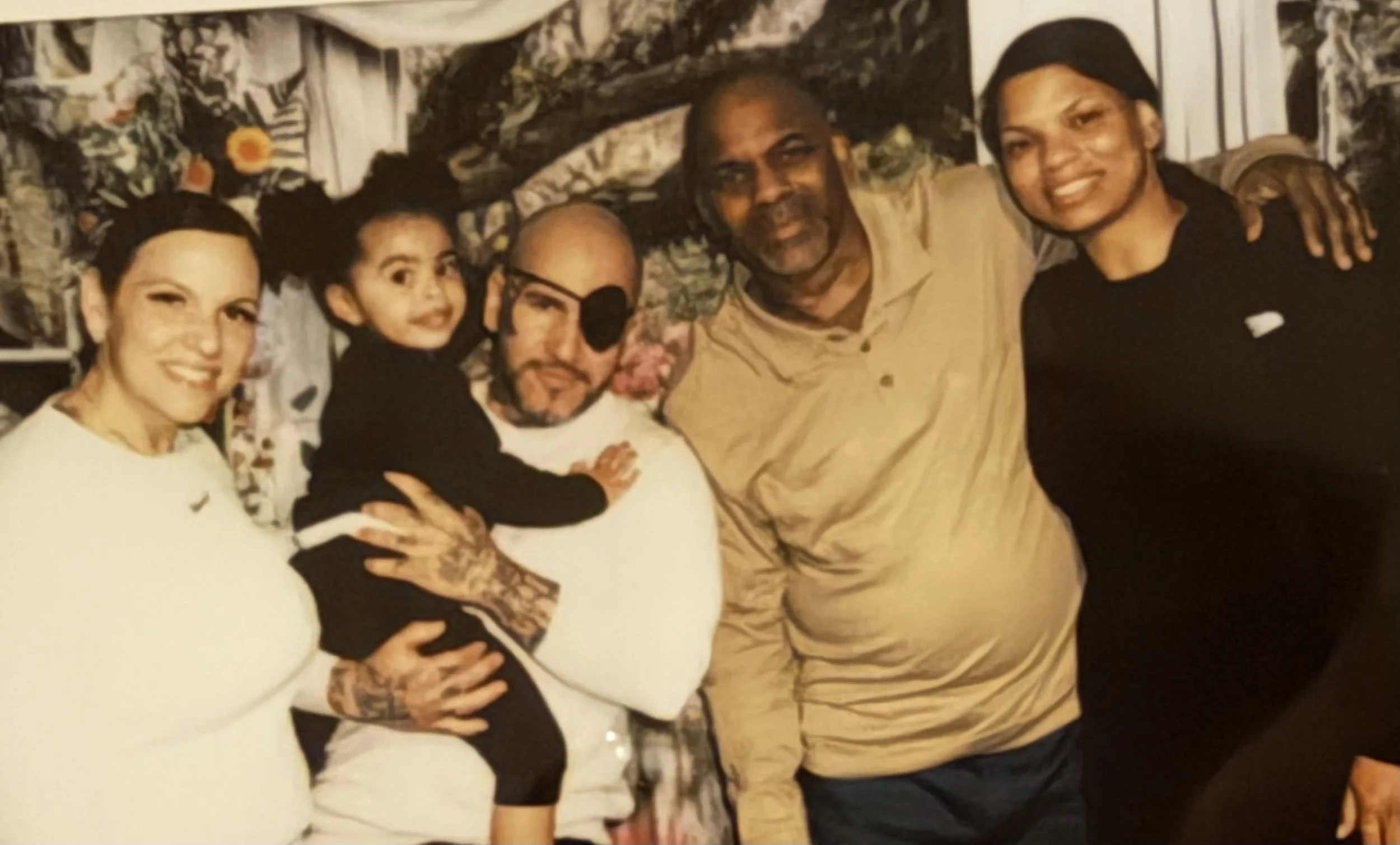
Left To Right
Stephanie Harris, Peyton Harris (niece of Jose Rodriguez, daughter of Stephanie Harris), Jose Rodriguez, Patrick Bowie (Father of Dr. Franchesca Capellan), Dr. Franchesca Capellan
Family Beyond the Walls: Reimagining Justice Through Family Systems and Human Connection
A Collaborative Reflection by The Jay Act Advocacy & Legal Reform Initiative & Family Systems Collective | Rooted & Rising Family-Centered Consulting
There are stories about incarceration that society has grown accustomed to hearing. Stories about punishment. About crime. About statistics, policies, sentencing structures, and prison populations.
But there are other stories rarely told.
Stories about grief.
About survival.
About love formed in places never designed to hold it.
Nobody talks enough about how strangers become family behind prison walls.
How men who were never supposed to know each other somehow become lifelines to one another through unimaginable suffering. Men enter prison carrying abandonment, trauma, shame, fear, and loneliness so profound it reshapes the way they move through the world. Some have not heard the words “I love you” in years. Some mourn parents, siblings, or children while confined to cells that leave no space for grief. Some watch entire childhoods pass through photographs and brief phone calls interrupted by automated reminders that time is running out.
And yet, somehow, a family is born there.
Not through bloodlines.
Not through legal ties.
But through survival.
One incarcerated man shares food with another who has nothing. One spends hours talking to someone about suicidal thoughts in the middle of the night. One teaches another how to read, write, regulate emotions, or reconnect with hope. One waits silently beside another after devastating news from home because he understands that grief inside incarceration becomes heavier when carried alone.
These relationships challenge dominant societal narratives about incarceration and humanity itself.
At Family Systems Collective (FSC), our work is grounded in the belief that families are not only biological structures, they are also relational systems built through connection, care, interdependence, and emotional survival. Through the lens of Family Systems Theory (FST), individuals cannot be understood in isolation from the relationships that shape them (Bowen, 1978). Human beings naturally seek attachment, regulation, belonging, and emotional stability within systems of connection.
Even within institutions designed around separation, hierarchy, punishment, and control, people still create systems of care.
That reality matters.
Family Systems Beyond Biology
Traditional understandings of family often prioritize blood relation or legal recognition. But Family Systems Theory reminds us that emotional systems form wherever human beings consistently support, influence, and regulate one another.
Inside correctional facilities, many incarcerated individuals experience profound disconnection from their families and communities. Physical distance, financial barriers, visitation limitations, shame, systemic neglect, and fractured relationships often weaken traditional support systems over time.
Yet human beings adapt.
In response to chronic isolation and institutional trauma, incarcerated individuals frequently create relational bonds that function as family systems. These connections become emotional anchors in environments where vulnerability is dangerous, and survival often depends on trust.
Men celebrate birthdays together with whatever they can gather: instant coffee, crushed cookies, and handwritten cards. They mourn deaths together in silence because grief inside prison is rarely given dignity. They protect one another emotionally and physically when systems fail to recognize their humanity.
And when someone finally returns home, pieces of him often remain behind with the men who carried him through the darkest moments of his life.
These bonds are rarely acknowledged publicly, yet they represent one of the most profound examples of human resilience.
Trauma, Survival, and Emotional Brotherhood
Research on incarceration consistently documents the psychological impact of confinement, including chronic stress, depression, hypervigilance, and trauma exposure. However, less attention is given to the informal emotional networks that emerge among incarcerated individuals themselves.
These relationships often function as protective factors.
Through the model of Family Systems Collective, we understand that healing does not occur solely through programs or policies. Healing also emerges through relational connection. In many cases, incarcerated individuals become each other’s emotional regulation systems in environments where institutional support is insufficient.
This does not romanticize incarceration. Prison remains deeply traumatic and structurally harmful. Families outside the walls continue to suffer separation, financial instability, emotional distress, and intergenerational trauma. Medical neglect, prolonged isolation, and systemic dehumanization continue to impact incarcerated individuals and their loved ones alike.
The Jay Act Advocacy & Legal Reform Initiative has powerfully illuminated how medical neglect inside correctional systems extends trauma beyond the incarcerated person and into the entire family system. Families experience helplessness, anticipatory grief, chronic anxiety, and emotional exhaustion while trying to advocate for loved ones denied adequate care.
But even inside these conditions, human beings still care for one another.
That truth deserves acknowledgment.
What Society Often Refuses to See
Public discourse frequently portrays incarcerated individuals through deficit-based narratives that erase complexity, tenderness, accountability, growth, and humanity. Yet many incarcerated people become caretakers, mentors, protectors, educators, listeners, and emotional support to others around them.
Some become fathers to younger incarcerated men who never had guidance.
Some become brothers to those abandoned by everyone outside.
Some become reminders that compassion can survive even within systems built around punishment.
At FSC, we believe this reality demands a broader reimagining of justice itself.
If human beings continue creating family, connection, and care under the harshest conditions imaginable, then what might become possible if systems themselves were designed around restoration rather than disconnection?
What would happen if policies were centered on healing?
If behavioral health support were prioritized?
If families were treated as partners rather than afterthoughts?
If dignity was viewed as foundational rather than conditional?
A Call for Human-Centered Justice
The FORMER partnership between Family Systems Collective and The Jay Act Advocacy & Legal Reform Initiative reflects a shared commitment to advancing justice through relational, family-centered, and human-centered approaches.
Our work recognizes that incarceration impacts entire ecosystems of people, not only those behind the walls. It also recognizes that healing, accountability, and transformation are deeply relational processes.
The emotional brotherhood formed within prisons should not exist because systems have abandoned people. But the fact that it does exist reminds us of something deeply important:
Human beings are wired for connection.
Even in cages, people reach for one another.
Even in suffering, people create belonging.
Even in systems built to isolate, people still build families.
And perhaps that truth says more about humanity than incarceration ever could.
References
Bowen, M. (1978). Family therapy in clinical practice. Jason Aronson.
Arditti, J. A. (2012). Parental incarceration and the family: Psychological and social effects of imprisonment on children, parents, and caregivers. NYU Press.
Murray, J., & Farrington, D. P. (2008). The effects of parental imprisonment on children. Crime and Justice, 37(1), 133–206.
The Sentencing Project. (2022). Parents in prison.