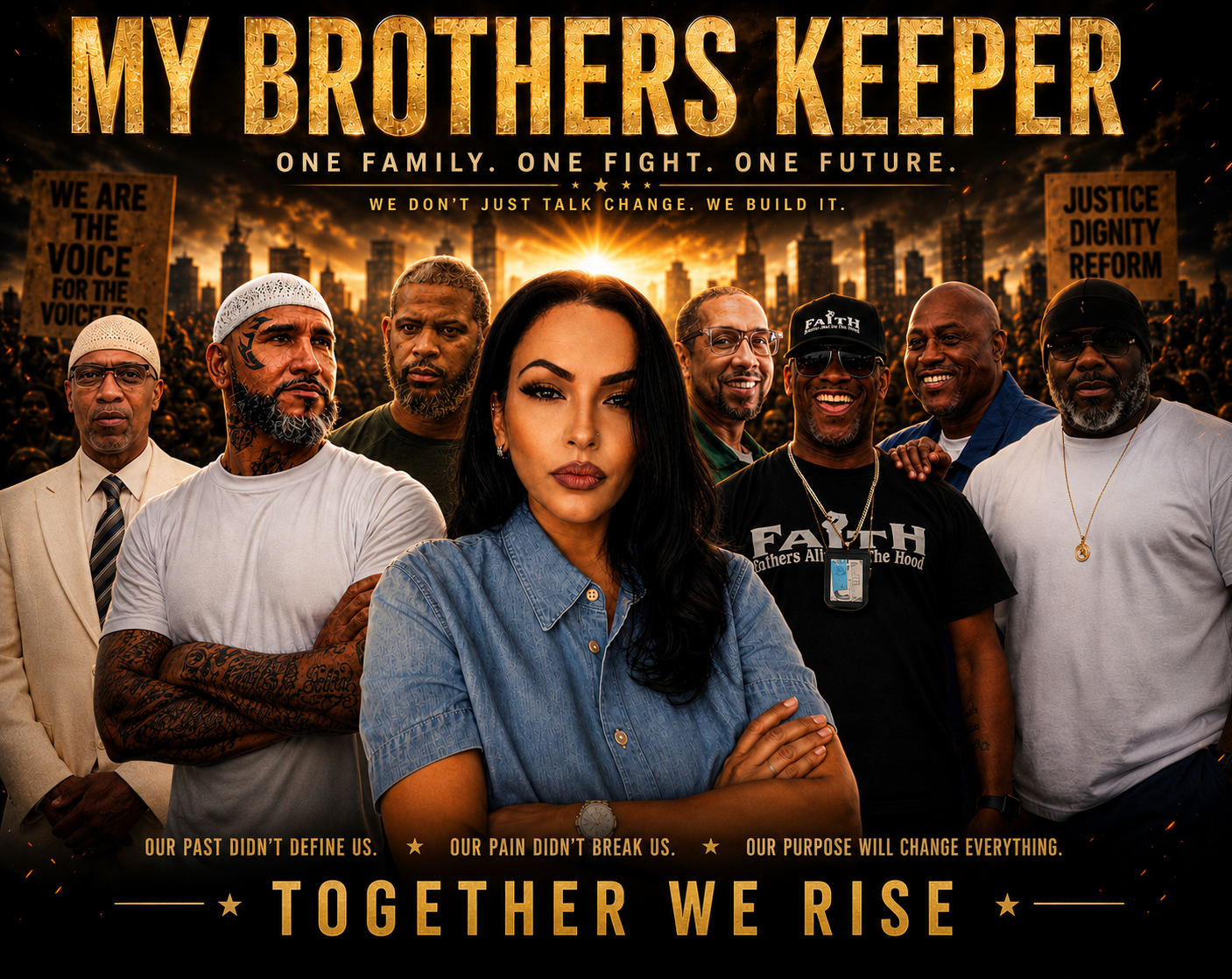
Dedication To:
Bruce Bryant, Jose “Jay” Rodriguez, Dupree “Turf” Harris, Salahuddin Tayden Townsley, Akil Townsley, Stanley Jamel Bellamey, Paul “Mustafa” Davidson.
All our brothers who society said “you’re not good enough”, yet TOGETHER WE RISE.
There are stories America celebrates, and there are stories America struggles to confront.
This is one of them.
To be my brother's keeper is not merely to love him when the world applauds him. It is to stand beside him when the world misunderstands him. It is to defend his humanity when statistics threaten to reduce him to a number, while never forgetting that behind every number is a son, a father, a brother, a dream, and a life that mattered long before anyone placed handcuffs upon it.
For centuries, Black Americans endured the brutality of slavery, followed by segregation, disenfranchisement, and legalized discrimination. Latino communities have likewise endured generations of exclusion, labor exploitation, unequal treatment, and barriers rooted in ethnicity, language, and immigration status. Though their histories are distinct, both communities have repeatedly confronted systems that too often limited opportunity while expanding punishment.
Those realities continue to echo today.
The United States incarcerates more people than any other nation in the world. Within that system, Black and Latino men are disproportionately represented. According to the U.S. Bureau of Justice Statistics, if incarceration rates observed in the early 2000s were to remain constant over a lifetime, approximately one in three Black males (about 33%) and one in six Hispanic/Latino males (about 17%) would be expected to spend time in state or federal prison, compared with about one in seventeen White males (about 6%). These figures are projections based on incarceration rates at that time—not predictions about any individual—but they illustrate the scale of racial disparities that researchers documented.
Statistics, however, cannot explain a mother's tears.
They cannot measure the silence at an empty dinner table.
They cannot calculate birthdays missed, fathers separated from children, brothers lost to decades behind concrete walls, or the generational consequences of neighborhoods where opportunity has too often been replaced by despair.
History reminds us that inequality rarely appears overnight. Residential segregation, discriminatory housing practices, unequal educational resources, employment barriers, and differences in access to healthcare have shaped life opportunities for generations. These structural factors do not determine any one person's future, but they help explain why disparities in wealth, education, health, and incarceration continue to exist across populations.
Yet if hardship defines one chapter, resilience defines the book.
Black communities have given America visionaries who transformed science, medicine, literature, music, law, education, and civil rights. Latino communities have strengthened this nation through military service, entrepreneurship, agriculture, public service, art, innovation, and culture. Their labor helped build America. Their brilliance continues to shape it.
To be my brother's keeper is not to excuse wrongdoing.
It is to insist that justice must never abandon humanity.
It is to believe that accountability and dignity can exist together.
It is to recognize that redemption should remain possible, that children deserve fathers, that families deserve healing, and that every person deserves to be judged by the fullness of their humanity—not solely by the worst chapter of their lives.
The struggle of Black and Latino America is not a narrative of weakness.
It is a chronicle of extraordinary endurance.
It is the story of people who continued planting seeds where others expected deserts. Who continued praying where others expected surrender. Who continued believing in tomorrow while carrying the weight of yesterday.
So when you ask me why I fight...
Why I advocate.
Why I refuse to become comfortable while others remain forgotten.
My answer is simple.
Because somewhere, another little boy is growing into a man who deserves more choices than statistics suggest.
Somewhere, another mother is praying her son comes home safely.
Somewhere, another brother is waiting for someone to remember that he is still human.
And until every life is afforded equal dignity, equal opportunity, and equal justice, our work remains unfinished.
Because being my brother's keeper is not simply about protecting one man.
It is about protecting the humanity we all share.
Together, we rise.
Sources
- U.S. Department of Justice, Bureau of Justice Statistics (BJS). Prevalence of Imprisonment in the U.S. Population, 1974–2001. This report estimated that, if incarceration rates remained constant at the time of the study, approximately 1 in 3 Black males (32.2%), 1 in 6 Hispanic males (17.2%), and 1 in 17 White males (5.9%) would serve time in state or federal prison during their lifetimes. Available at: https://bjs.ojp.gov
- U.S. Department of Justice, Bureau of Justice Statistics. Prisoners in 2023. Annual statistical report documenting racial and ethnic representation within state and federal prisons. Available at: https://bjs.ojp.gov
- The Sentencing Project. Report to the United Nations on Racial Disparities in the U.S. Criminal Justice System. Examines racial disparities in policing, sentencing, incarceration, and the long-term impact of criminal justice policies. Available at: https://www.sentencingproject.org
- The Sentencing Project. One in Five: Racial Disparity in Imprisonment. An analysis of contemporary racial disparities in imprisonment rates across the United States. Available at: https://www.sentencingproject.org
- Prison Policy Initiative. Mass Incarceration: The Whole Pie. An overview of incarceration trends and demographic data across the United States. Available at: https://www.prisonpolicy.org
- U.S. Census Bureau. QuickFacts: United States. Population demographics used for comparisons of incarceration rates among racial and ethnic groups. Available at: https://www.census.gov
