THEY TOOK HIS EYE, BUT THEY COULD NOT TAKE HIS VOICE
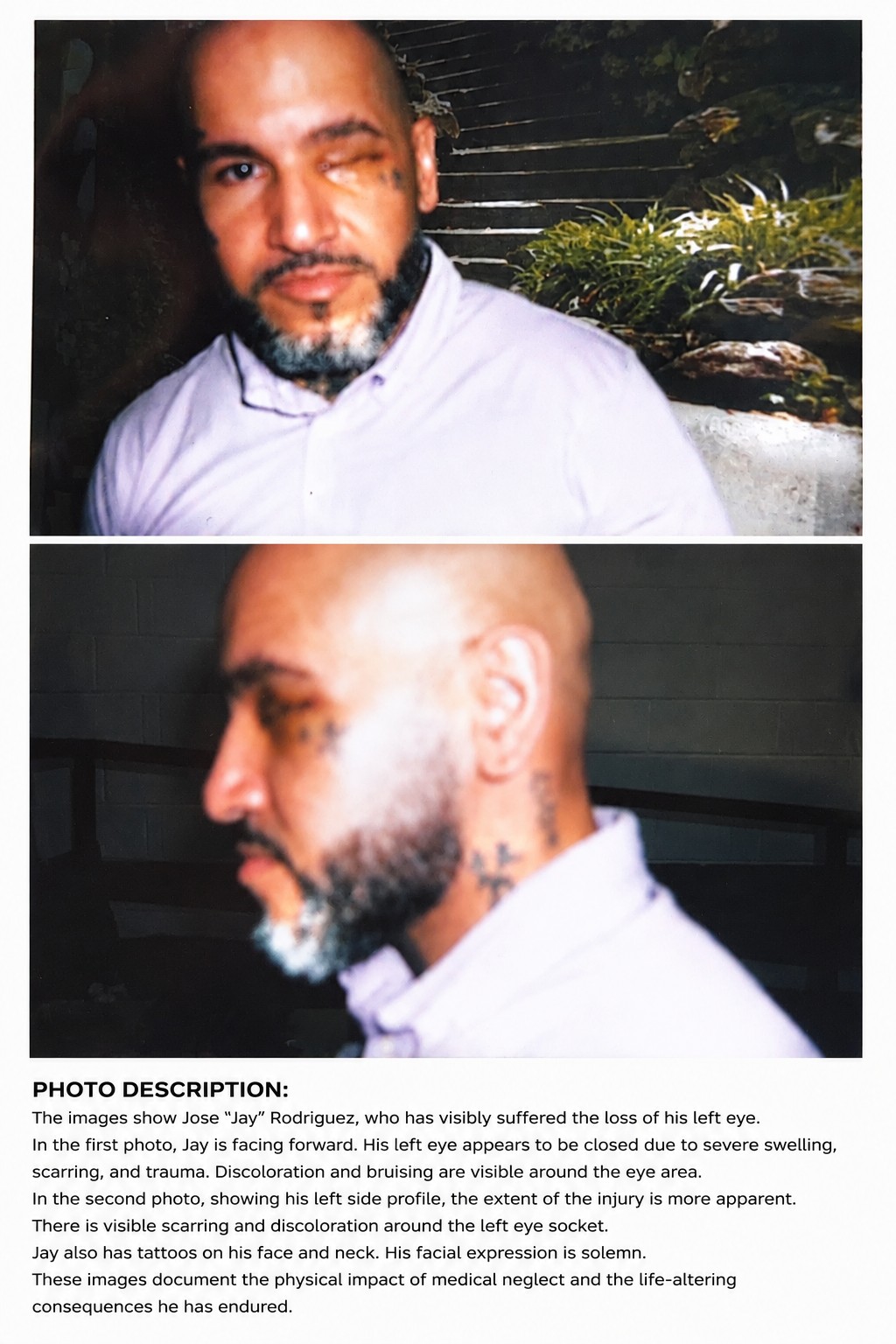
There are photographs that demand our attention.
Not because they are graphic.
Not because they are shocking.
But because they force us to confront a truth we would rather ignore.
The photographs of Jose "Jay" Rodriguez are those photographs.
When you look at them, you are not simply looking at the devastating effects of cancer. You are looking at the consequences of delay, indifference, and a system that too often treats incarcerated human beings as though their suffering matters less.
You are looking at what happens when cries for help go unanswered.
You are looking at what was taken from a man who spent years proving he was more than the worst decision he ever made.
For years, Jay reported worsening symptoms. His condition continued to deteriorate. The pain intensified. His vision declined. The cancer advanced. Yet despite repeated opportunities to intervene, the disease was allowed to progress until the unthinkable became reality.
He lost his eye.
Let those words sink in.
Not his privileges.
Not his recreation.
Not his television.
His eye.
A part of his body.
A part of his humanity.
A part of his life that can never be restored.
But the horror did not end when the surgeons removed the eye.
In many ways, another chapter of suffering began.
After enduring the physical and emotional trauma of losing an eye, Jay should have been provided every safeguard necessary to protect his recovery. Instead, according to reports from his family and advocates, he was returned to conditions that raised serious concerns about sanitation, medical oversight, and basic human dignity.
This was a man recovering from the removal of an organ due to cancer.
A man with an open surgical wound.
A man vulnerable to infection.
A man who had already paid an unimaginable price.
Yet reports described leaking conditions, fruit flies, inadequate living arrangements, and concerns regarding access to appropriate post-operative care.
Think about that.
Imagine waking up after losing an eye to cancer.
Imagine trying to process the trauma.
Imagine learning to navigate the world with altered vision.
Imagine wondering whether the cancer has spread elsewhere in your body.
Then imagine being forced to worry about whether the environment around you is safe enough to heal.
No human being should have to endure that.
What makes this even more disturbing is that Jay's suffering was not hidden.
His family spoke out.
Advocates spoke out.
Medical concerns were raised repeatedly.
Warnings were given.
Emails were sent.
Calls were made.
Yet the damage had already been done.
The eye could not be saved.
And even after that loss, the burden of fighting for adequate care continued.
What makes this tragedy even more difficult to accept is that Jay's story is not the story many people expect when they hear the word "prisoner."
This is a man who transformed his life.
A man who embraced accountability.
A man who became a mentor, an advocate, and a source of hope for countless others.
A man whose growth and redemption were so profound that even New York State Department of Corrections and Community Supervision Commissioner Daniel F. Martuscello III acknowledged the remarkable person he had become.
Yet while his redemption was recognized, his suffering continued.
The contradiction is impossible to ignore.
The system praised the man.
But failed to protect the patient.
The system acknowledged his growth.
But did not prevent his loss.
The system spoke about rehabilitation.
But rehabilitation means little when a person's health is allowed to deteriorate beyond repair.
Jay's story exposes a painful reality.
We often speak about incarceration as though the punishment is the sentence itself.
But for far too many incarcerated people, the punishment becomes something more.
It becomes delayed medical treatment.
It becomes ignored symptoms.
It becomes preventable suffering.
It becomes irreversible damage.
And in some cases, it becomes death.
Across correctional facilities, incarcerated individuals report delays in specialist referrals, postponed testing, interrupted treatment plans, and barriers to receiving care. Families frequently describe spending months or years begging for intervention while watching loved ones deteriorate from behind prison walls.
Most of those stories never make headlines.
Most of those faces are never seen.
Most of those voices are never heard.
Jay's story became visible only because the damage became impossible to hide.
The photographs tell the story words alone cannot.
They show the cost of delay.
They show the cost of indifference.
They show the cost of a system that too often waits until a crisis becomes catastrophic before responding.
And perhaps the most haunting question remains:
If this happened to a man whose rehabilitation was acknowledged by the highest levels of the correctional system, what is happening to the countless others whose names we do not know?
How many are suffering right now?
How many families are sending desperate emails tonight?
How many people are living in pain while waiting for someone to care?
Jay lost an eye.
But he did not lose his voice.
And that voice now speaks not only for himself, but for every incarcerated person who has ever been told to wait while their condition worsened.
For every family forced to beg for medical attention.
For every person whose suffering was treated as an inconvenience instead of an emergency.
These photographs are not merely images of one man's injury.
They are evidence.
Evidence of what happens when human beings become invisible.
Evidence of what happens when suffering is normalized.
Evidence of why accountability is no longer optional.
Because no person should have to lose an eye before someone decides their pain matters.
And no family should ever have to wonder whether their loved one will survive long enough to finally be heard.
